
Smart SafetyWear
While maintaining public streets and highways, roadway construction workers have to balance their attention to completing their tasks with their overall safety in relation to the surrounding traffic vehicles moving around their work zone.
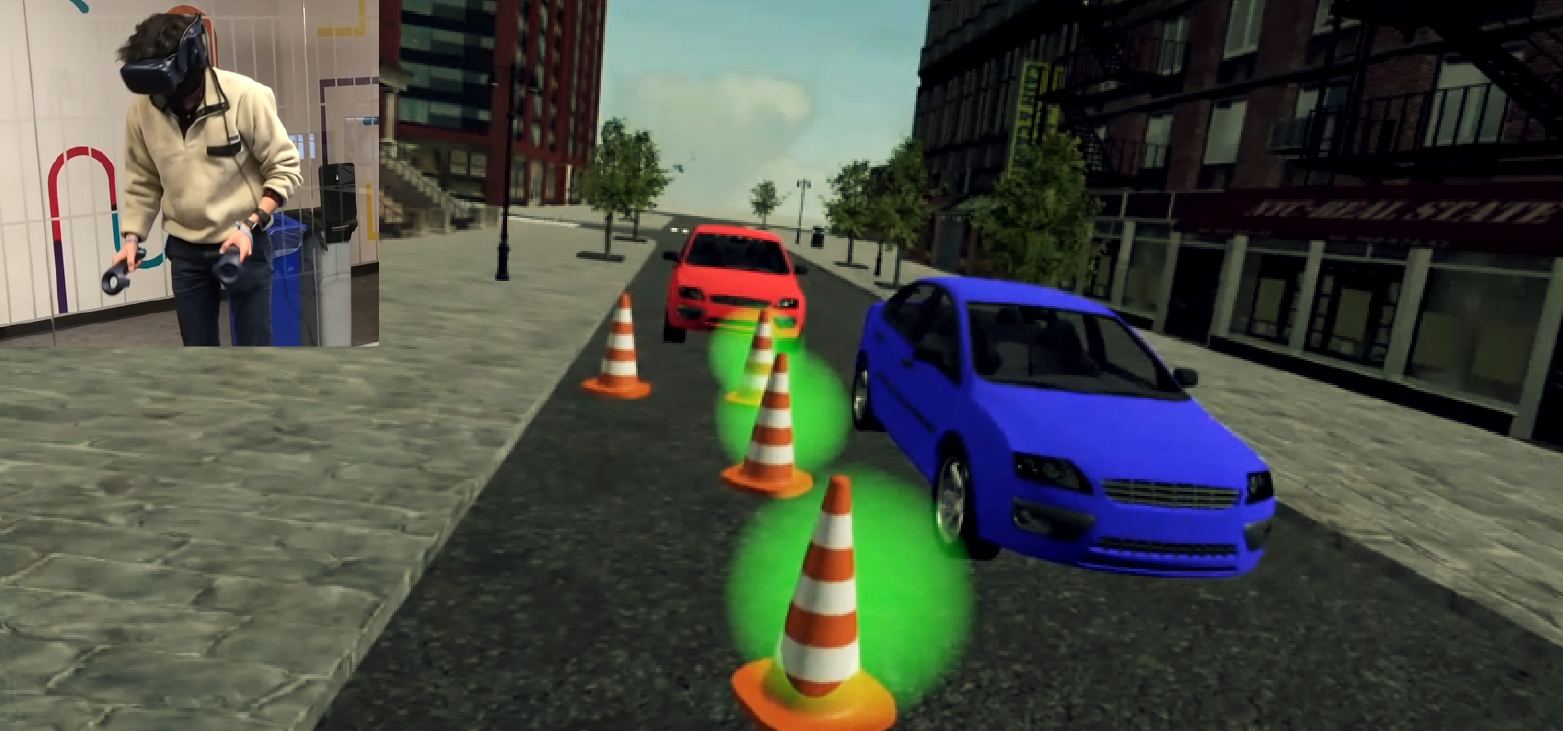
What if a wearable device (e.g., smartwatch) could intelligently warn workers of dangerous vehicles (e.g., speeding cars)? What aspects of worker behavior (head movement vs body movement) would be important to keep track of? What kinds of alarms (e.g., sound vs haptic/vibration) are effective? How could an AI, aware of a worker’s current behavior and surrounding traffic, pick the best alarm to raise on the wearable device? And how can we safely design and test such a smart wearable device without risking workers’ lives?
My PhD dissertation investigates how virtual reality (VR), wearables, and machine learning can be used to improve roadway worker safety the following ways:
1. Understand worker behavior: Collect data on how construction workers move during roadwork and train AI models to predict their movements (i.e., trajectory prediction).
2. Understand worker reactions to alarms: Collect data on how construction workers react to different alarms triggered by dangerous vehicle and analyze which alarm attributes (duration, repetitions) have the greatest safety impact.
3. Develop AI-based alarms: Use that collected data to train AI (i.e., reinforcement learning) to pick alarms that are most likely to prompt an individual worker to react safely and consistently over their entire workday.
All of the above methods can use a safe yet immersive work zone simulation where researchers can closely monitor a construction worker’s risks and behaviors in otherwise life-threatening traffic construction scenarios.
Towards a future where smart wearable devices can help prevent construction worker-related traffic accidents, this research demonstrates how VR provides a testbed staging area for prototyping novel AI applications prior to their real-world testing and deployment.
More info upon request by contacting dbl299 [at] nyu [dot] edu.
Technical Skills
Unity, HTC Vive API, Virtual Reality Systems, C#, Python, PyTorch, Reinforcement Learning, watchOS, RaspberryPi, Ultrasonic Sensors, Wearable Prototyping
Publications
Lu, D. B., & Ergan, S. (2026). Behavioral modelling of roadway construction workers: Improving deep learning-based trajectory prediction with contextual information in traffic work zones. Advanced Engineering Informatics, 71, 104277. doi:10.1016/j.aei.2025.104277
Lu, D. B., & Ergan, S. (2025). Principal attributes of wearable warning alarms to promote roadway worker safety. Advanced Engineering Informatics, 67, 103481. doi:10.1016/j.aei.2025.103481
Lu, D., Ergan, S., & Ozbay, K. (2025). Reinforcement learning-based optimal control of wearable alarms for consistent roadway workers’ reactions to traffic hazards. Journal of Transportation Safety & Security, 1-25. doi:10.1080/19439962.2024.2449119
Lordianto, B., Lu, D., Ho, W., & Ergan, S. (2024). Hapti-met: A construction helmet with directional haptic feedback for roadway worker safety. In: Riveiro, B., Arias, P. (eds) 2024 EG-ICE International Conference on Intelligent Computing in Engineering, Vigo, Spain, July, 2024. PDF
Lu, D., & Ergan, S. (2023). Predicting roadway workers’ safety behaviour in short-term work zones. In: Broy, T., Li, H., Lu, Q. (eds) 2023 EG-ICE International Conference on Intelligent Computing in Engineering. PDF
Qin, J., Lu, D., & Ergan, S. (2023). Towards increased situational awareness at unstructured work zones: Analysis of worker behavioral data captured in VR-based micro traffic simulations. In: Skatulla, S., Beushausen, H. (eds) International Conference on Computing in Civil and Building Engineering (pp. 63-77). Cham: Springer Nature Switzerland. doi:10.1007/978-3-031-32515-1_6